0

[this was originally posted at Brian's personal blog, From Baghdad to Baga]

I’ve been spending a lot of time thinking about content recently. In my latest project I’m working with Video Volunteers to establish a network of community producers (or community journalists) all over India. These Community Producers will be generating at least 1-2 videos per month, as well as a variety of other social content, ranging from SMS updates via Twitter or a local gateway running something like FrontlineSMS, to blogging and recording audio via phone.

My current goal is to start the network with 40 Community Producers, this is a number based on everything I’ve discussed with colleague here, regarding available candidates, capable candidates, and our own limitations, for example to qualify a candidate must speak Hindi and/or English. If we are successful at launching the project with such a broad and diverse network, we very quickly start dealing with some really large numbers. In the first month we will produce between 40 and 80 *different* videos per month.

The first question anyone might ask at this point is, will anyone watch that many videos online from one network or news agency? Although the answer may be no, I’m hoping its a clarified no, I’m hoping there is a body of viewers who will be interested to watch at least half or two-thirds of the content being produced each month. Unfortunately, the number of viewers who will be ultimately interested in the content if they can see it is something somewhat outside of our control.

My attempt to determine what elements I can control has led me to conceive of the term “watchability.”

The greater the “watchability” of the content, the more likely the video will be watched. Of course this risks being a self-fulfilling paradigm, where we might say that if a video is watched, of course it has watchability and if it isn’t then it doesn’t.

I’m endeavoring toward a theory of watchability that is not so irrelevant to the rest of us as such a frivolous take might be.

So let’s start from the most basic element, in order to be watchable a video must have a certain quality level to the content. That means the image should not be too shaky, and the audio must hit at least a modicum of tolerability regarding the ratio of signal to noise.

In order to be watchable a video must be compelling, which is to say it should show us something new and interesting, it should provide us a new take on an old story. This new and intriguing perspective should be shown, not told. It doesn’t have to be funny, but being funny, or entertaining, or exciting are all elements that can greatly increase a videos watchability. It can be easier to succeed at thrilling or entertaining an audience than to be compelling in another more dramatic fashion.

Keep in mind we are looking toward a definition of extreme or complete watchability, what elements should a video contain for the greatest watchability.

To make a video that is compelling is easiest if it also reflects a dominant paradigm in the audience’s worldview. This is why we are so willing to accept images or stories as fact that later prove to be false. Videos have perhaps the greatest viral watchability, and can even become exponentially more compelling when they contain content that directly reflects the expectations of the audience they reach in a new and shocking way. It can also be compelling by virtue of being extremely personal or communicating something intimate about the individuals pictured or the individual producing the content.

For example the video of Neda during the Iran election protests was extremely watchable. So too was LonelyGirl15 and even before YouTube was likely a spark in Chad Hurley’s imagination, a young Kuwaiti named Nayirah convinced the world that Iraqi soldiers had taken Kuwaiti children from incubators and “left the babies on the cold floor to die.” Her story was “watchable” because Americans wanted to believe it, and the press did little to question the elements, exactly because they reflected the dominant paradigm.

So watchability isn’t always necessarily a good thing. However reflecting one’s worldview can also be a matter of tenor, ie negative or anti-government videos for some, positive uplifting images of heroic justice for others. This may also be why humor is such a connecting element across boundaries of culture and differing perspective.

Keeping that in mind, is there anything else that provides a video watchability? I would suggest that perhaps the single most important element of watchability, even after reflecting the audience’s dominant perception of an event, is audience accessibility.

Videos must reach the audience where the audience is willing to consume the videos. Thus YouTube videos might have a higher base-level watchability than other video-sharing sites, purely as an element of market share. Another interesting element is that videos from the Iraq and Afghanistan wars have greater watchability if they are published at Liveleak.com purely by virtue of the fact that consumers of such videos tend to spend much of their time looking at Liveleak to find the latest and “greatest” gore from the War on Terror.

The onus is now on the producer/publisher to push videos out as far and wide as possible. The very watchability of a video depends on it. Accessibility and paradigm reflection can improve the watchability of a video that might otherwise be consigned to the dustbin of internet video waste. The most beautiful and telling story of corruption or suffering or pain of an oppressed people might also lack watchability if it is not made accessible to a willing audience.

In order to have watchability videos now must be accessible via RSS, iTunes, Facebook, Twitter, YouTube, and a host of others, the level of importance of any one networking tool being directly related to the audience a producer/publisher is targeting.

I hope you’ll comment with your own ideas and theories of “watchability.” Even with 10 years experience producing and consuming online video, one individual cannot hope to come to a solid and complete definition of such an elusive topic.

But at the risk of extreme hubris, I’ll postulate this; to succeed at creating a video with the greatest watchability, a video must:

* contain content with a marginal level of quality, a steady image and not too much noise in the audio
* be compelling, showing us something new, or something personal
* despite showing us something new, it should reflect the existing worldview of the audience
* it must be accessible. all television content possesses watchability purely by being on television, our audience is more dispersed, so our content must be as well.

What else makes a video watchable?

How many of these elements will we have to achieve to succeed at building a vast audience and keeping them? As I said at the beginning, to some degree that is really unknowable, but pursuing a theory of watchability may be the best chance at creating a benchmark for measuring success and how to alter our planning and execution to potentially increase our watchability.

Some thoughts so far from Twitter:

JoeyNiebrugge

@BaghdadBrian compelling, human angle, educate viewer (culture, people, lifestyle), entertain, quality* visuals (*often lacking)

NickySides

@BaghdadBrian “watchability” grabbing hook for initial attention. personalize it so that ppl not normally interested in the topic relate

Dimitrijevic_66

@BaghdadBrian Re what makes a video watchable? : Brevity. Under 90 secs is best and state running time up front

Post your own response here or on Twitter!

Continue Reading

0

[Reposted from http://brianconley.info

I saw an interesting discussion on Twitter this morning(late night their time, remember I’m in India at GMT+5.5). A variety of #mediaagitators were discussing the term “voiceless.”

Here is a selection:

@digidem “Tweets and Blogs: Social Media as a Voice for the Voiceless” @emjacobi invited to give talk at American University on community empowerment

@SamGregory @DigiDem Is anyone truly voiceless? Or they are just being ignored if/when they use their voice?

@audaciaray .@lksriv @SamGregory @DigiDem I really hate it when people are referred to as “voiceless” – so patronizing and disempowering

@maymaym Yes! We’re not voiceless—they’re not listening. ♺ @audaciaray: Hate it when ppl are referred to as “voiceless.” Patronizing & disempowering.

@emjacobi @audaciaray @lksriv @samgregory – i’ve been off twitter all day, but i agree completely that no one is “voiceless” & said so.

I fully understand that there is a distinction between being voiceless and being unheard or ignored. I am concerned that for the privileged, and lets be clear, anyone who has direct access to Twitter counts as “privileged” in my book, it can be problematic or worrisome to spend too much time discussing the semantics of our relationship to power and privilege.

Perhaps we can work toward an effective and meaningful definition of those we’d like to be collaborating with?

The primary issue I see with the term “voiceless” is that by defining someone you’d like to collaborate with as disempowered you have immediately created a power divide. You cannot help but stratify your relationship if you define your relationship as one based on their need and your support.

At Small World News we have primarily worked to see how we can use our privilege to support others to magnify their voice, to strengthen their broadcast, and, at our core, provide the skills and support that is asked for, and then get out of the way.

However, I’ve tried hard not to fetishize semantics such that I might exaggerate the capabilities of those with the least access. It can be equally difficult to help those who have never spoken for themselves to know what they have to say. How do we describe someone who does not know what they’d like to say, as a result of generations of disempowerment?

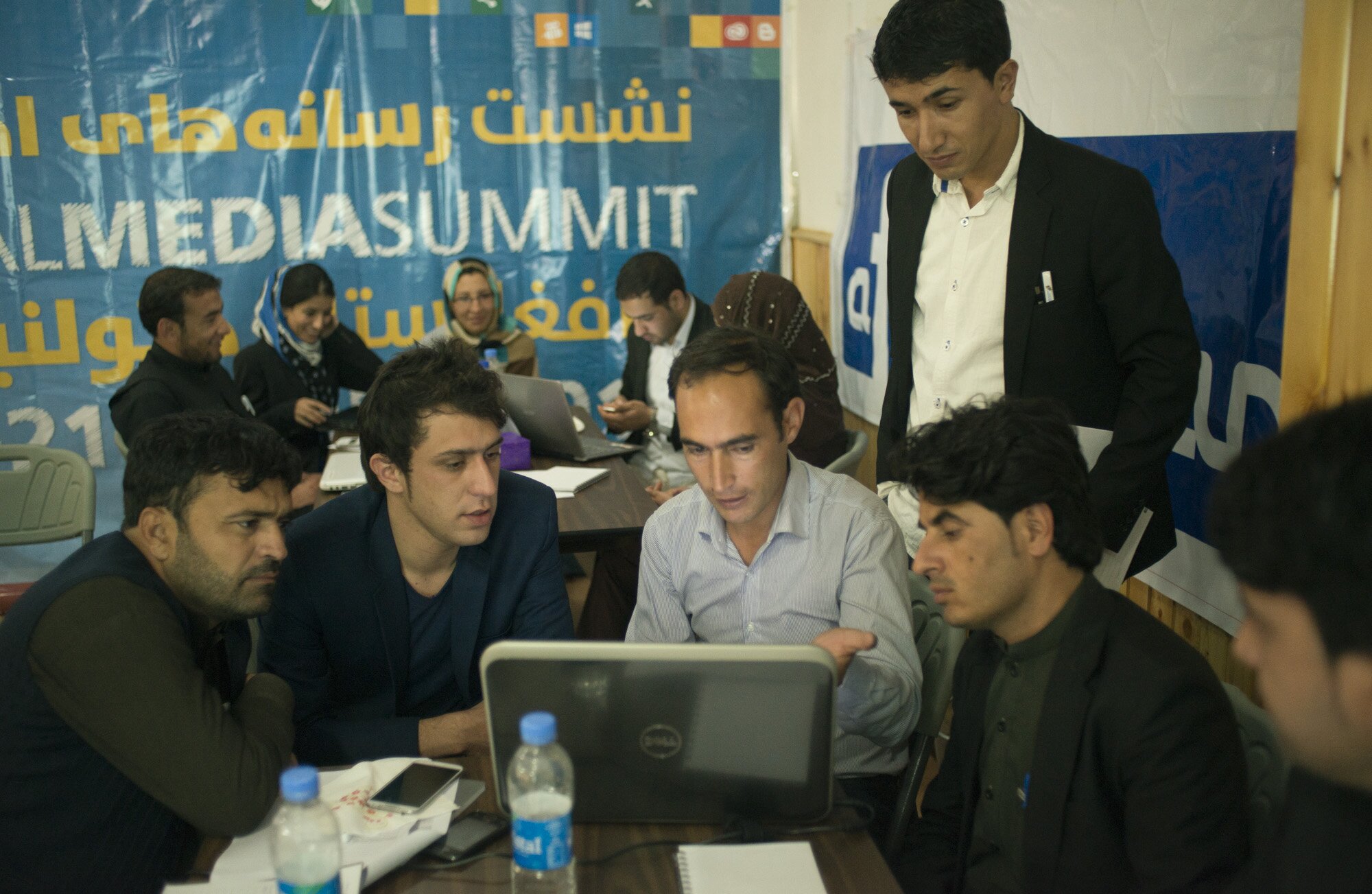
Today I am in India working on creating a loose network of Community Producers, social activists trained to be journalists who will help shed light on the disparate issues facing their communities that have, until now, never been accessible to the commons, to a wider community beyond a small geographic area. It is likely they have as much a need to be heard as to understand what they might say and how it might benefit their local community.

The willingness to listen and ability to have patience to a fault may be more important than trying to provide the tools for others to access the digital communications space.

Do you think the term “voiceless” is at all helpful?

Can we work together toward a more meaningful definition of those who lack access to the media commons, to the digital commons, who have never been listened to, and reflexively may at first appear to be “voiceless?”]

Continue Reading

1

Yesterday it came to my attention that the Utne Reader named me one of 50 Visionaries Who Are Changing Your World. I have to first say that I am shocked, and secondly that I am honored. The whole thing is a bit strange and surprising.

In fact, I found out when a friend mentioned it to me on my Facebook wall! It’s a bit strange that Utne doesn’t appear to have notified many, if any, of its 50 Visionaries. That said, I can’t accept such an honor without making it clear that the work of Alive in Baghdad and other Small World News projects would not be possible without the efforts of our local collaborators, who put their lives on the line every day.

Without individuals like Ali Shafeya who gave his life trying to tell stories about the militias in Iraq, I am sure that I would never have been considered for such an award. Today, in order to honor the contributions of our local staff we are continuing to build on Small World News and seeking funding to construct a nation-wide network in Iraq and Afghanistan. Small World News is founded on the belief that locals have a fundamental role in telling stories of their lives.

In conflict areas it is a necessity to leverage the access and perspective of locals to increase understanding across ethnic lines, as well as internationally. In such a way Small World News hopes to improve the delivery of development dollars and increase the relevance of foreign policy decisions.

Regarding the Afghan conflict, there is wide acceptance that without a mechanism for qualitative assessment of the Afghan perspective, the United States cannot “win.” Despite this agreement, there is no mechanism yet in place. We believe Small World News is well-situated to construct such a mechanism, improving Afghan life and security.

Continue Reading

1

According to a recent San Francisco Chronicle article posted on SFGate.com:

The international aid agency Oxfam says USAID awards more than half of its Afghan aid to just five U.S. private contractors with close political ties in Washington: KBR, the Louis Berger Group, Bearing Point, DynCorp International and Chemonics International. USAID allows contractors to budget $500,000 annual salaries and benefits for high-ranking employees, and $200,000 for lower-ranking administrators, according to Rashid. All expatriate employees receive a bonus of up to 70 percent for hazard and hardship pay. The average Afghan civil servant, however, receives less than $1,000 a month.

Rashid and other critics say waste is built into the system. Expatriate employees bank most of their salary because companies pay for employee travel and living expenses.

Now, the cure for what some might call corruption or others, charitably, the misdirection of funds, is outside the purview of Small World News. However, later in the article, this brings something to mind:

Afghan officials and aid workers say smaller nongovernmental organizations that emphasize people-to-people aid have helped Afghan society and have kept overhead costs low. Former Finance Ministry adviser Rashid said Washington should rely more on such groups and Afghans themselves to administer future programs.

But Rashid concedes that direct funding of the Afghan government and contractors could also lead to increased corruption, a problem that has gained significant ground since the Taliban regime fell. But he says a multilayer system with improved oversight could diminish fraud.

As I wrote yesterday, we believe that an independent media network, staffed with local journalists, in collaboration with international direction, and an international focus, could make great steps toward improving the use of aid as well as an understanding of how Afghans really feel about subjects as disparate as US airstrikes, new roads, and the Karzai lead government. Without taking a stance on supporting local observation and accountability, we can’t reasonable expect to improve our relationship with the locals, can we?

Small World News proposes to build a local network and report on all manner of issues. We would be open to taking direction/requests on topics of coverage from development agencies and others, but we would expect independence. Only by valuing the work of locals, while keeping them honest and responsive, without the interference of other government interests, can we use technology to create a transparent and in-depth picture of the happenings all over Afghanistan.

Only by prioritizing the perspective of locals can we build honest and open dialogue toward increased international peace and stability. Only by learning who the Afghans are that we speak so much about, can we step back from the exoticizing and ridiculous obsession with “arming” or “bribing” the tribes. This has been tried many times, by Britain ni the 1800s, by the Soviets in the 80s, by the post-Soviet government in the 90s, and by the US in 2001-see Northern Alliance. Arming the tribes brings us to our current moment.

With a local network sourcing content and teaching the world about Afghanistan, collaborating with an international team building the platform and distributing content, as well as combining quantitative data to improve how we analyze the reporting, we can have a thoughtful, successful strategy for assisting Afghanistan with its current moment, and look forward.

Continue Reading

2

Sourcing accurate information is one of the most difficult elements of any work in Afghanistan, from counter-insurgency to investment and reconstruction. We are currently detailing a plan to establish a local media network in Afghanistan. Although such projects exist, we feel there is a very important niche still missing.

Media networks established abroad with the support of development agencies and foundations, typically have a very local-focus, where the goal is increasing transparency and democracy within the society. While this is certainly valuable and important work, this is not what we are proposing. Furthermore, the implementation of new media strategies and Web 2.0 technology that is gaining more and more of a presence in the United States and the developed world in general is too often overlooked in these programs.

Small World News proposes to establish a presence initially in one province, where one full-time Afghan journalist, and a handful of part-time contributors will produce original content. We will also continue to expand the reach of crowd-sourcing technology, such as Ushahidi and FrontlineSMS to enable local citizens, as well as aidworkers and others, to contribute short updates, photos, and, if they wish, longer pieces. Our paid contributors will have assignments ranging from interviewing local communities to judge their opinion on all manner of issues, to producing photo and video series measuring the progress of reconstruction projects in their areas.

With this method we believe it possible, fairly quickly, to begin sourcing detailed reports from the field. By hiring Afghans with local knowledge and local experience we can go direct to the source, interviewing local Afghans within the communities affected by development projects, security operations, and insurgent action. We have demonstrated capability in difficult environments such as Baghdad, Mexico, and Gaza. During the recent Afghan election we demonstrated the ability to quickly stand-up media tools and build partnerships with locals to provide comprehensive coverage on election day and after, from all over Afghanistan.

Small World News will not just produce local news content, all content will be produced with an eye toward the international community. All content will be produced with geotags and, using GIS technology, we will produce reports combining our qualitative data (first-hand local reports) with quantitative data, such as water access, ethnic makeup, presence of international forces, and essentially any relevant data available.

Such a media network provides the development community with the information it can’t obtain alone. The risks of operating in a dangerous environment like Iraq, and the difficulty replacing experienced aid workers and foreign service officers confine all but the most intrepid civilians to compounds, with rare ventures to the field behind armored cars and heavily-armed bodyguards. In order to understand how development projects are affecting the local community, as well as the impact of foreign support for various individuals in the political establishment, we need reports from the field, and highly trained local journalists are in the best position to do this work.

Our proposal also fulfills a major requirement posited in General McChrystal’s assessment(PDF) of the Afghan security situation. He mentions repeatedly the need to implement civilian as well as military action and reforms. General McChrystal makes it very clear that we must have qualitative as well as quantitative assessments in order to accurately judge progress and improve our efforts to stabilize and rebuild Afghanistan. Despite his clear emphasis on this need, there is no proposal for a mechanism to produce such assessments.

We propose to build that mechanism, in the form of an independent, national news network, producing local reports with an eye toward the international community. Not only will such a network solve many of the difficulties facing development agencies and stability operations, by producing open reports available to all, it will improve the the international community’s understanding of life in Afghanistan.

We need your help to make this happen. Although we have demonstrated success in all manner of areas producing independent and citizen journalism projects, we lack the proper contacts for funding, fundraising, and individuals at USAID and larger foundations who might fund such a network. Please get in touch with us immediately if you can provide assistance with any of these issues, and please tell your friends about our proposal and our capabilities.

Continue Reading